In December 2000, David Agar left a refugee camp in Kenya after living there for 9 years, and came to America. He had fled war torn Sudan, trekking 8 months to escape Sudanese government soldiers according to an article in the Pittsburgh Post-Gazette written by Steve Levin ("Lost Boy" from Sudan, who found himself in America, killed on Uptown Street, Pittsburgh Post-Gazette, 31 January 2006). 3 days ago, he died -- shot to death in an apparent robbery.
What a sad story. He had dreams -- "plans" as Levin writes. After enduring so much hardship, it seems so unfair. If anything, David Agar's story helps put into perspective our insignificant day-to-day complaining. See the entire story below...
http://www.post-gazette.com/pg/06031/646995.stm
Tuesday, January 31, 2006


Saturday, January 28, 2006
"Limited" Immigration
While Dr. D was reading the Emma Lazarus poem, "The New Colossus," I remembered my middle school days. For one reason or another, I had a free period to do whatever I wanted. Instead of playing outside, I found myself in the school library trying to look up the history of the Statue of Liberty. Liberty...what a great word. I find it interesting (and possibly ironic?) that the Statue of Liberty was commissioned by a few noted Frenchmen to celebrate the centennial of America's independence. A way, if you will, to celebrate America's pursuit for "human liberty." That the Lady Liberty was and still is the iconic symbol for immigrants to travel to America where there was a melting pot of ideas and innovation. Where is that melting pot now? In a January 9th, 2006 Wall Street Journal article titled, "How U.S. Immigration Evolved As the Nation Grew and Changed," the author, Cynthia Crossen notes that the issue of immigation and its concerns that are prevalent even today (i.e. a surplus of poor unskilled workers taking jobs from today's Americans) were also present in the early 20th century. So, this issue of immigration, while seemingly new, has actually been a concern for more than 80 years. Questions as to whom should we allow? Are there exemptions if the individuals seeking entrance into the US from "designated" countries? Who defines all of this? Even now, this past fall the Department of Homeland Securitty (DHS) has sought to revamp the questions on the U.S. Citizenship test. Whether or not those questions will be tougher or easier is up for debate, though most signs point to a toughening of questions. Given all the above, there seems to be a tension between accepting people seeking human liberty and those undermining American job security. What are your thoughts?
Friday, January 27, 2006
When the United States is in bed with tyrants
The United States finds itself in an unusual position, or perhaps not. In a recent New York Times article, "Rights Groups Fault U.S. Vote in U.N. on Gays" (January 7, 2006), the United States has backed a measure that was introduced by Iran to prevent two gay rights groups a voice at the United Nations. Cuba, Sudan and Zimbabwe also sided with Iran and the United States.
On the one hand, we condemn these countries for their human rights abuses, yet, when it suits our "morality" or perceived morality, we agree with them. So what is the lesson here? Are gays inhuman? Do they not deserve a voice in the United Nations?
Ironically, the United States grants "persecuted homosexuals" asylum under the category of "membership in a particular social group", yet, homosexuals in the United States are treated as second class citizens. Granted, they might not be tortured or killed by the U.S., government, but they can't serve in their military (at least as openly gay soldiers), they cannot get married in most states, they do not have protection from discrimination in employment, housing or many of the other day-to-day things that hetersexuals take for granted.
The United States is supposed to be the leader of the "free world". Aren't we supposed to be setting an example of civil and political rights? By continually ignoring and deliberately undermining the rights of a minority -- homosexuals -- the United States is not only undermining the human dignity of a group of people, but it is undermining the human dignity of a nation.
On the one hand, we condemn these countries for their human rights abuses, yet, when it suits our "morality" or perceived morality, we agree with them. So what is the lesson here? Are gays inhuman? Do they not deserve a voice in the United Nations?
Ironically, the United States grants "persecuted homosexuals" asylum under the category of "membership in a particular social group", yet, homosexuals in the United States are treated as second class citizens. Granted, they might not be tortured or killed by the U.S., government, but they can't serve in their military (at least as openly gay soldiers), they cannot get married in most states, they do not have protection from discrimination in employment, housing or many of the other day-to-day things that hetersexuals take for granted.
The United States is supposed to be the leader of the "free world". Aren't we supposed to be setting an example of civil and political rights? By continually ignoring and deliberately undermining the rights of a minority -- homosexuals -- the United States is not only undermining the human dignity of a group of people, but it is undermining the human dignity of a nation.
Internally Displaced Peoples
It's so easy to forget about millions of people who continue to live in squalled, life-threatening conditions, far from their homes: the "Internally displaced peoples". As Donald Steinberg in his Christian Science Monitor article (URL link below) alerts us, these are the world's lost people - they are "neither refugees nor citizens". What do we do with them? How do we help them? The recent plight of thousands of children in Northern Uganda fleeing the Lord's Resistance Army rebel group has made headlines, but still, night after night the "night commuters" seek shelter in bus depots, schools and other public buildings, just to avoid adbuction. Who should be taking care of this? What should be done?
Dr. D.
http://www.csmonitor.com/2006/0127/p09s03-coop.html?s=hns
Dr. D.
http://www.csmonitor.com/2006/0127/p09s03-coop.html?s=hns
Thursday, January 26, 2006
Why Are Immigrants so Hated?
The recent brutal beating of a 13-year old Liberian boy in Philadelphia sent chills through the immigrant community. The boy was "punched in the mouth and then stomped on by a group of youths until his jaw was broken and he had bleeding on the brain". See: http://www.centredaily.com/mld/centredaily/news/local/crime_courts/13688872.htm
This is not an isolated event, especially since 9-11. Many immigrant attacks have been on immigrants mainly from Muslim populations. Can we just brush this off as a consequence of fears arising from the 9-11 attacks, or is there something deeper, more foreboding about these attacks?
This is not an isolated event, especially since 9-11. Many immigrant attacks have been on immigrants mainly from Muslim populations. Can we just brush this off as a consequence of fears arising from the 9-11 attacks, or is there something deeper, more foreboding about these attacks?
Monday, December 05, 2005
Is The War in Iraq a "Just War"?
By Noor M.
"No to America, No to Saddam” –Protestors in Baghdad after Friday prayers.
"Our enemies are innovative and resourceful, and so are we. They never stop thinking about new ways to harm our country and our people, and neither do we." —George Bush, Washington, D.C., Aug. 5, 2004
George W Bush has made some devastating mistakes in his “war against terrorism” that the Iraqi citizens are paying for with their lives. The U.S. led invasion in Iraq is far from just. In fact, I say it is UNjust because of a variety of reasons. However, some people consider war a necessary evil. Just war theorists believe there are a certain conditions that justify its occurrence. I will analyze the war in Iraq using these subjective conditions to determine whether the invasion of Iraq could be termed “just.”
The first condition to a “just war” is that the intervention’s basic intention must be just. The U.S. administration initially used the attack on the twin towers to justify the invasion to the American people. In his October 2002 speech George Bush said, “Saddam Hussein is harboring terrorists and the instruments of terror, the instruments of mass death and destruction. And he cannot be trusted. The risk is simply too great that he will use them, or provide them to a terror network.” This in fact was untrue, no weapons of mass destruction were or any active facilities building nuclear weapons were found in Iraq. Bush also claimed there were ties between Saddam Hussein and Al Quaida and once again this was proven untrue. A large part of the international community and certain Americans believe that the reason the U.S. invaded Iraq was because Iraq has the second largest deposits of oil in the Middle East. Could that be called a “just” intention? Or is stealth a more appropriate label? (Considering that the Iraqi Oil Ministry is heavily influenced by the American occupation to make decisions that favor U.S. policies).
The second condition to a “just war” is that the intervention be carried out by a legitimate authority. The United Nations has been given the difficult task of resolving conflicts between nations in our current system of anarchic world politics. A hegemonic power i.e. the United States is not a legitimate authority. That would be breaching the nation’s sovereignty—a consequence that must be avoided as decided by the international community since the Treaty of Westphalia in 1648. The United Nations never sanctioned an invasion into Iraq; in fact, it was against the U.S.’s actions in Iraq. The U.S. administration set a dangerous precedent in Iraq by undermining the authority of United Nations—the solitary international organization founded to monitor relation between nations.
The third condition on just war states that intervention cannot be launched for immoral reasons under the guise of doing good. As I explained before the Bush administration falsely led the people in the United States into believing that Saddam was harboring weapons of mass destruction and that there was a direct connection between Hussein and the Al Quaida terrorists. The evidence presented that Hussein had bought Uranium from Niger to make a bomb was dismissed by the U.N. inspectors as crude forgeries. Are the people supporting the war not phased by the revelation of the absence of credible evidence? The spread of democracy and protection of the Iraqi people (questionable as these reasons are) seem to satiate the American population still supporting the war. Do those Americans not care that their president lied to them about going to war? Does the international perception of this disgusting lapse on part of the U.S. intelligence not bother them? I speculate the real reasons are in fact, money, power and credibility.
The fourth condition states that intervention must be the last resort; all peaceful alternatives must have been exhausted. I will not defend Hussein’s actions because I do believe in his philosophy. However, the United Nations did not approve the invasion of Iraq partly because the Security Council as a whole did not believe that all peaceful alternatives had been exhausted. The U.N. did not think the evidence presented by the U.S. was sufficient to breach Iraq’s sovereignty. More importantly, even if that were the case, the reasons given for invading Iraq were not true.
The fifth condition to a just war states that the intervention must have reasonable chance of success. The U.S. led invasion absolutely fulfills this one condition of a “just war.” However, simply fulfilling this condition does not justify the invasion of Iraq. On the contrary the U.S. was so much more powerful than Iraq that it makes the invasion more unjust. Iraq never really had much of a chance against the U.S. which is militarily stronger than the rest of the world combined. Does being militarily strong give a hegemonic nation the right to expect that the rest of the world will cater to its every demand?
The last condition of a just war is that the intervention’s cost must not exceed the importance of its outcome: the means & ends must be proportional. More than 2000 American soldiers have died in Iraq and the unofficial count for Iraqi civilians is between 20,000 and 30,000 people. The United States has also committed some appalling human rights abuses in the process of “combating terrorism.” Currently it holds 70,000 detainees captive all over the world! Is the spread of freedom and democracy in Iraq worth these lives? More importantly, is democracy exportable? If so, is Iraq ready for democracy? If Americans genuinely believe so, then they must now fulfill the responsibility they bestowed upon themselves by setting up the dangerous precedent of Iraq. They must protect the citizens of every nation that believes it is under the rule of an autocratic regime.
I rest my case. You can announce the verdict. Was the war in Iraq a “just war?”
Extra links:
CNN: http://www.cnn.com/SPECIALS/2003/iraq/forces/casualties/
BBC: http://news.bbc.co.uk/1/hi/in_depth/middle_east/2002/conflict_with_iraq/default.stm
WAR ON IRAQ: SPREADING DEMOCRACY OR TERRORISM?
By Iren A.
The problem with deciding if the war on Iraq is justified or not is that the proclaimed motives have changed since the beginning of the war. The decision to invade Iraq was announced when American people were wounded by the horrible events that occurred on September 11. Americans have never been more scared off Islam Fundamentalists and terrorism. So when President Bush announced that they had 'intelligence' that there might be weapons of mass destruction in Iraq, suddenly there was no question about it. Eliminating Saddam would give the same satisfaction to some Americans as eliminating al Qaeda would. However, there were no weapons of mass destruction found.
One would think that after that everyone would realize that America went into Iraq for nothing. There was no proof that Saddam Hussein was connected to any of the terrorist groups that attacked/was planning to attack America. He didn't possess a threat against United States, since by now everyone knows that in the 21st century it is not possible to threaten or deter America without nuclear weapons. Then why did people still continued to support the war on Iraq? Because the Bush Administration suddenly presented a new motive for the war on Iraq. America might not have gone to Iraq for the right reasons, but they may as well stay there for the right reasons: humanitarian intervention. US is the only country that can take out Saddam, and save the Iraqi people from suffering, therefore it's the US's job to do it. It is our job to spread democracy, and give freedom to people around the world. But if that's the case, why doesn't US intervene in Sudan? When there are dictators around the world doing the same thing Saddam did, if not worse, why doesn't US invade those countries as well? Because we're already in Iraq. Then another question: was there really a genocide, a mass murder of civilians going on in Iraq that called for a humanitarian intervention?
First of all, if there was a genocide going on, it has been going on for a long time. For example, it was going on in 1988 when chemical weapons on Kurdish villages were dropped, or in 1991 when Bush supported Saddam on the war against Iran. [1] And humanitarian intervention would have been justified on those cases. However, the director of Human Rights Watch, Kenneth Roth argues that research shows in 2003 only "smaller scale killing" -torture, imprisonment, nothing more than America practices today on 'suspected' terrorists- was going on in Iraq. [1]
Even if there was a genocide going on, we know that America wouldn't intervene without trying other alternatives, or without the approval of the Security Counsel. In fact, waiting for the approval of UN is what delayed most Western countries, including US, to intervene in Rwanda. Is it just that when it's not to our own self-interest, we play with words so that we don't have to call it a genocide. But when it is to our own -self interest- we have no problem accepting it. Even Cheney highlighted the fact that one of the reasons America went to war was that Iraq was "seated atop ten percent of the world's oil reserves, Saddam Hussein could then be expected to seek domination of the entire Middle East, take control of a great portion of the world's energy supplies". [2] Then at least, we should show that if not the only motive-the dominant motive is humanitarian intervention, and it is in the best interest of the civilians, not dangerous to the civilians. In other words, when there is a humanitarian intervention going on, it must be done in a way that respects humanitarian laws-therefore not start fires in heavily populated areas, or when there is not enough intelligence that the target is going to be there, and other 'inexact methods' US uses. [1]
So around 30,000 Iraqi people and 2,000 US soldiers have been killed.[4] And it might even be worth it if even though the motives were all wrong, at the end Iraq would be at a better place than before. It will all be better if the democracy really works for Iraqi people. But is it really what they want? Are the American people helping by still controlling their lives? After interviewing Iraqi citizens, Nir Rosen concludes that: "As the occupation wears on, more and more Iraqis chafe at its failure to provide stability or even electricity, and they have grown to hate the explosions, gunfire, and constant war, and also the daily annoyances: having to wait the hours in traffic because the Americans have closed off half the city; having to sit in that traffic behind a U.S. military vehicle pointing its weapons at them; having to endure constant searches and arrests". [3] US is there because it wants to prevent civil war between Sunnis, Shi'ias and Kurds. But Rosen concludes that most Sunnis are fighting because of revenge: "Revenge for the destruction of their homes, for the shame they felt when Americans forced them to the ground and stepped on them, for the killing of their friends and relatives by U.S. soldiers either in combat or during raids". [3] He goes on to say that "Were America not in Iraq, Sunni leaders could negotiate and participate without fear that they themselves would be branded traitors and collaborators by their constituents". [3]
While we are criticizing the way Saddam and those other 'ignorant' people use force to get what they want, we're using the same methods. More and more terrorists see on TV the way Americans treat Islamic fundamentalists, and the more and more they think that they were right to think that America is really the enemy, they are really trying to eliminate Muslim people. And the more they want to harm that enemy, and take revenge for the way they treated other Muslims. 2001 will not be the last time America seriously suffers from terrorism. This summer will not be the last summer suicide bombers try to blow themselves up along with civilians in London.
So no, I don't think the war on Iraq is justified. Not just because the motives were wrong, a lot of people were killed, and human rights were violated. Because instead of eliminating terrorism, it is helping to spread it.
Works Consulted:
[1] Roth, Kenneth. "The War in Iraq: Justified as Humanitarian Intervention?", The Theodore M. Hesburgh, C.S.C., Lectures on Ethics and Public Policy, April 20, 2004.
[2] Richard Cheney, United States Vice President, stated in his remarks to the Veterans of Foreign Wars 103rd National Convention on August 26, 2002, http://www.usiraqprocon.org
[3]Rose, Nir. ""If America Left Iraq", The Atlantic Monthly, December 2005, p 42-46.
[4] http://en.wikipedia.org
Monday, November 28, 2005
Gay rights = Special Rights?

Are Gay Rights, Special Rights? Why should homosexuals be allowed to marry? Why should they be given any special treatment against discrimination (employment, housing, education etc., etc.,?) What is does the "gay rights" movement stand for? The right to wear pink, purple of fushia? Aren't there more important things to worry about, other than whether "gays" have any special rights? What does being "gay" really mean? Is it a choice, biologically determined, or just an "in" thing to be? Are gays different from other human beings? Should they be treated with the same respect if they go against the covenants of the Bible, the Koran, or any other religious text?
Below, our guest blogger, Rachel H., offers some perspectives.
The Supreme Court believes that there is a constitutional right to marry. Yet homosexuals are not included in this group who have a constitutional right to marry. A majority of US citizens believe that gay people have different rights from heterosexuals; hence the re-election of Bush in 2004. Obviously that’s not the only reason he was re-elected, but same sex marriages was a hot topic for that election; Bush’s campaign appeared to be about the moral values of citizens. During that same election, eleven states amended same sex marriages through the ballot. People seem to fear homosexuals or else they would not be treating them like unwanted outcasts. It is much like when African Americans were struggling for essential rights; then it was white v. black, now it is gay v. straight. There seems to be a constant struggle for equal rights for all.
Diane Miller argues that there is no “other group of American citizens who are currently less protected under the U.S. Constitution than are gays and lesbians.” There are general amendments that obviously apply to everyone such as freedom of speech, but there is no specific amendment those focuses on giving homosexuals more rights as a group. I would like to think that in the next 20 an amendment will exist in the constitution specifically for same sex marriages. Unfortunately, it may take that for homosexuals to gain equal rights. Right now gay couples in Michigan “who work for the state are losing their benefits because of the vote to ban same sex marriages and similar unions.” All over the country bills are being passed to inhibit the rights of homosexuals.
In 2003 Lawrence v. Texas, two men were arrested for sodomy in their own home. The Supreme Court ruled that Texas could not make sodomy illegal between consenting adults. It’s a step in the right direction, but legally a same sex couple have no rights. If they decide to adopt a child, only one is the legal guardian and the other has no rights, if something happens to the other partner or to the child. That is what homosexuals are fighting for. They are not fighting for special rights; they are fighting for rights that are inherent in any heterosexual marriage. Although, many would disagree with my argument because they believe that homosexuals are something to be feared. It’s as though being gay or lesbian is contagious, and if you give them too many rights it will spread to everyone in the country. It’s ridiculous and without support or evidence.
Another important issue surrounding gay rights is the military. Originally, the military would not allow gay people in the army. Then Clinton developed the “Don’t ask, don’t tell” policy. It allows homosexuals to be in the army as long as they “convince their superiors that they were celibate.” It is absurd that homosexuals would be allowed to participate as long as no one knows their sexual orientation. Why is sexuality something to hide and be ashamed of? It is not something that a person can choose or change. It is an inherent quality a person is born with. Gay people do not want special rights, but citizens against gay marriages and such seem to understand gay people as special; therefore, they believe that gay people should have special rights. Evan Gerstmann’s book revolves around her argument that “the Constitution has, does, and should protect everyone’s fundamental right to marry the person of his or her choice…. This does not require gays and lesbians to ask for special rights or protections.” The constitution should protect homosexuals so they would not have to fight for equal rights. By Rachel H.
Works Cited
Gerstmann, Evan. Same Sex Marriage and the Constitution. Cambridge: Cambridge University Press, 2004.
Goodman, Ellen. “Must Gay Rights Wait for Our Comfort?” The Boston Globe. December 16, 2004.
Miller, Diane Helene. Freedom to Differ. New York: New York University Press, 1998.
Toobin, Jeffrey. “Sex and the Supremes”. The New Yorker. August 1, 2005.
Tuesday, November 22, 2005
What's Your Beef?
What's pissing you off? leaving you sleepless at nights? What do you think needs to change?
What are your needs, desires or pet peeves?
Drop a note!
Dr. D.
What are your needs, desires or pet peeves?
Drop a note!
Dr. D.
Monday, November 21, 2005
Torture Lite?
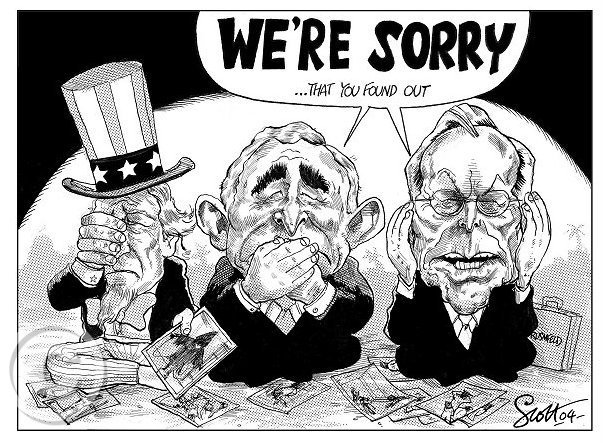
The United States is at a historic time right now. Vice-President Cheney is calling for a legalization of "cruel, inhumane and degrading treatment" -- sometimes called "torture lite". The justification pits liberty and security issues against one another. In other words, in order to preserve the security of the United States post 9-11, the argument goes, sometimes individual liberties have to be suspended. Two guest bloggers below, Victoria R., and Francis M offer their perspectives. The comic is from: www.scottclissold.com/.../ images/ustortpics.jpg.
Torture Time by Victoria R.
Torture is the new pink. Lets face it, torture is used in more that 150 countries, criminals as well as criminal suspects have been subjected to torture in more than 130 countries, people have died as a result of torture in more than 80 countries, torture has been used against political prisoners in over 70 countries, torture has been used against non-violent demonstrations in over 70 countries (1) and these are just the cases that we know about.
On January 27th 2005, President Bush said, “torture is never acceptable, nor do we hand over people to countries that torture.” (2) Clearly, the times are changing. Not only is President Bush’s statement incorrect, but Vice President Cheney is currently trying to pass an initiative that would authorize cruel, inhumane and degrading treatment of prisoners abroad, essentially promoting the use of torture by U.S. officials. (3)
The United States has always prided itself on being the most influential and powerful country in the world. So it is no surprise that “it has become the leader in the violation of human rights . . . As a society, we haven’t figured out what the rough rules are yet . . . It’s the law of the jungle. And right now we happen to be the strongest animal.” (2) The United States faces a new military threat, unlike one that we have ever seen. The emergence of rogue states with access to nuclear weapons as well as terrorists with global aims have rivaled the existing world order and has created the need for a new foreign policy.
In 1998 Congress passed legislation that made it illegal to “expel, extradite or otherwise effect the involuntary return of any person to a country in which there are substantial grounds for believe the person would be in danger of being subjected to torture.” Though when extraordinary rendition, a secret program created during the Clinton administration was created, the legislation was overridden. After 9/11 extraordinary rendition was the clear solution to dealing with terrorists. In fact, it was originally created to “detect, disrupt, and dismantle terrorist operations” (2) so what better policy could there be to deal with suspected terrorists? The United States has perfect allies to be our torture partners.
In 2002 the U.S. State Department human rights report for Egypt detailed detainee treatment: they were “stripped and blindfolded; suspended from a ceiling or doorframe with feet just touching the floor; beaten with fists, whips, metal rods, or other objects; and doused with cold water and sexually assaulted.” (4) The United States had the intelligence regarding Egypt’s torture tactics and Egypt owes us for the large amount of foreign aid we give them, so it was a perfect situation.
Just like politics in the United States, torture has become bureaucratized. Instead of sending terrorists to other countries for them to do our dirty work and torture people who might have intelligence, we have decided to do it ourselves abroad. As more and more suspects were apprehended the US had to expand extradition locations as well as use resources like Guantanamo Bay, because after all, “once a detainees rights have been violated you absolutely can’t reinstate him into the court system.” (2) The United States could sleep easy because rough tactics have the possibility to save hundreds of lives. And even though “nine out of 10 people can be persuaded to talk with no ‘stress methods’ at all .. . [and] true of religiously motivated fanatics . . . that the ‘batting average’ might be lower: ‘perhaps six out of ten.’ [And] If you beat up the remaining four? ‘They'll just tell you anything to get you to stop." (5) Torture tactics for that one regular person or for those four religious fanatics are surely worth it for the possibility that lives may be saved.
Now that it has become public knowledge that extraordinary rendition is used and that enemy combatants are held and tortured at Guantanamo Bay, it is the next logical step for the United States to legalize the torture. Why have hidden black sites? Why not just come out and call them torture camps? “That’s the world these folks [terrorists] operate in. And its going to be vital for us to use any means at our disposal, basically, to achieve our objective.” (2) Vice President Cheney makes a very valid point here, if they’re doing it there is no reason that we shouldn’t do it. It doesn’t matter that they are a rogue, stateless Terrorists and we are a DEMOCRACY. I mean “why is it so hard for people to understand that there is a category of behavior not covered by the legal system? . . . Historically there were people so bad that they were not given protection of the laws.” (2) Terrorist fit this category so they shouldn’t be protected under the law. And if your suspected of terrorist acts you shouldn’t be protected either. And if you know something or know someone who is a terrorist you shouldn’t be protected either. Desperate times call for desperate measures.
But one must stop and ask at some point, if we continue our policy of doing whatever it takes regardless of international laws, human rights, and treaties we have signed and continue to torture as many people as it takes to win the war on terrorism that maybe, just possibly, a barrier is crossed. What makes us different from Egypt or other countries that are known to torture? That we don’t torture on our soil? Or that we don’t torture our own citizens? If the United States takes a good look at herself she might realize that she has found an enemy that has no regard for human rights and has no problem killing innocent people. And if she looks even closer she will find that she has become a state that tortures, even publicly promotes torture and that there is no difference between the ruthless enemy and us. We are own worst enemy.
REFERENCES
(1) "Torture Worldwide: An Affront to Human Dignity." Amnesty International USA. 18 October 2000. Amnesty International.
(2) Jane, Mayer. "Outsourcing Torture." The New Yorker February 14 2005: 105-121.
(3) "Vice President for Torture." Washington Post 26 October 2005: A18.
(4): "Country Reports on Human Rights Practices- 2002." U.S. Department of State. 31 March 2003. Bureau of Democracy, Human Rights, and Labor.
(5) Mark, Danner. "We Are All Torturers Now." The New York Times 6 January 2005.
Some good references:
http://en.wikipedia.org/wiki/Torture
http://web.amnesty.org/pages/stoptorture-index-eng
Torture is Okay Sometimes, Francis M.
Throughout history torture has been used as a tool to get information or verbal knowledge out of an individual, and to this day we still use the same barbaric tactics. The question at hand is whether torture, torture lite, C.I.D (cruel, inhuman and degrading) H.C.I (Highly coercive interrogation) etc. are “sometimes” acceptable? The debate about torture has not been so much of a moral argument as it has been an empirical conclusion. Where to draw the line on the use of coercive force in interrogation is a pressing issue that has been endlessly debated.
The easiest solution is to band any kind of physical abuse. There are other tools and techniques that do not involve breaching our commitment to the Geneva Convention, the United National Convention Against Torture (ratified by the United States, with reservations, in 1994) and other no-torture agreements. There are other techniques that could be used that would not infringe on civil liberties, constitutional rights, and moral values. By signing agreements, we are making a statement of obligation to credence. When we sign than make our own ratification, our agreements are no longer legitimate.
The saying: “treat others the way you want to be treated” goes to show that if we are not capable of demonstrating the right way to treat people, then we should not expect it of others. Granted that this is just a notion that helps humans to harmonize and get along, but it also portrays a pretty accurate generality about human treatment. It is hard to say that if we treated every criminal or terrorist with equal liberties and rights that of a US citizen, that they would do the same. To justify this, we would be the bigger person in the end. In some senses, torture is stooping down to their level.
Even though torture has been around forever, there is still no evidence in which it has been proven to be 100% effective. If the administration is pushing for a “torture lite” resolution, at least there should be a compelling argument that it has been proven to be effective and efficient and that sufficient research has been conducted.
Public knowledge on this issue is also another major problem. If the public is not well versed on the issue, than do we just rely on the government to make these kinds of decisions for us. Mark Bowden argues
The public’s understanding of torture is too simplistic. While the ‘civilized would’ has condemned all forms of torture, Bowden explains that there are different kinds of torture- and different kinds of people who are subjected to it. There is a vast difference, Bowden writes, between using cattle prods to wring false confessions out of Chinese prisoners and using sleep deprivation and rough handling to get lifesaving information from captured terrorists. In fact, the word ‘torture’ does not even apply when interrogators employ only moderate physical and psychological pressure, Bowden argues; he and other prefer the term ‘coercion’.
This issue is tough to delineate a boundary and drawl a line through what is morally right and wrong. I do think that it is an obligation as a society as a whole to come to a conclusion and find some sort of moral honesty. The public awareness is lacking and this issue needs to be addressed more seriously.
Another problem that torture presents is that it just may be a “shortcut for a lazy or incompetent investigator.” It seems as though whenever torture is convenient, it maybe used, for example after 9-11. “The public is going to respond to the current circumstances. If Americans are angry, they’re going to favor torture. If they’re feeling comfortable and secure, they’re going to be against torture”
The easiest solution is to just ban torture or any form of it all together. If any kind of physical abuse is going to occur, than it should be at the risk of the inflictor and that should be the final ruling. Finding a balance between what is right and wrong is too complicated and there will always be violations. “If you open that door, then there’s no stopping it. Because everyone will use torture; everyone will assume that his or her circumstance is justified. As long as torture is banned, you can only employ it as your own risk.”
References:
Zagorin, Adam (2005) “Haunted by ‘The Iceman’”,Time Madazine, 21 November, pp. 38-46.
“The Truth About Torture”, The Atlantic Monthly, September 11, 2003, pp 1-6.
Lelyveld, Joseph (2005) “Interrogating Ourselves”, The New York Times Magazine, 12 June, pp. 1-12
Beatty, Jack (2005) “Fighting Terrorism with Torture”, The Atlantic Monthly, 27 May, pp.1-2.
Monday, November 14, 2005
The Face of Torture, by Susan Dicklitch
Torture is an ugly word. But what does it really look like? I recently found out when I sat through the testimony of a thirty-something Cameroonian woman who was seeking asylum in the United States.
Claudette (not her real name) clutched her hands nervously as she sat in the sterile immigration courtroom. She was surrounded by her support team, a Harvard-trained pro-bono lawyer working for a large law firm in Washington, a clinical psychologist specializing on victims of torture, a representative from C.A.i.R Coalition (Capital Area Immigrants’ Rights Coalition), and me, a country conditions expert on Cameroon.
Within two to three hours, Claudette would find out her fate – whether she would remain in the United States, or be deported back to Cameroon and possibly face more torture. It was no wonder that she was so nervous. Only one out of five asylum cases that are referred to an immigration judge are granted asylum.
It is estimated that about 5,000 asylum seekers are held in detention in the United States, awaiting their immigration court hearing. Since 1996 with the implementation of the Illegal Immigration Reform and Immigrant Responsibility Act (IIRIRA), any asylum seeker who enters the United States without proper documentation is detained. Also, unlike criminal law, asylum seekers are not entitled to the equivalent of a public defender. If they can afford to hire a lawyer, or have pro-bono legal advice, they are lucky, if not, they have to present their case in an adversarial hearing, pro se, in front of a government trial attorney, and an Immigration Judge. Asylum seekers have to prove that they have both a subjectively and objectively credible “well-founded fear” of past persecution and/or future persecution.
Claudette had a better chance than most – she had a team of experts working for her, and she was not in detention.
But this was little consolation to Claudette who looked so frail and scared, struggling to retell her encounter with torture. She spoke of being forced to watch others being tortured, of being threatened with rape and electrocution of her private parts. She showed us scares from cigarette butts put out on her arm, and she recounted how she was forced to clean up the human feces left in the prison cells. It was the smell that still haunts her on a daily basis, so much so that she refuses to eat very much to avoid having to defecate.
She started to talk about her third and final detention in one of Cameroon’s most notorious prisons, La Gendarmerie du Lac. Because she was Francophone and required a government-issued translator, there was often a pregnant pause between questions from the Immigration Judge and the BICE (Bureau of Immigration and Customs Enforcement) trial attorney, and the translated response. When the translator asked her to repeat herself at one point, Claudette lost it, screaming out, “du Lac”, “du Lac”, sobbing uncontrollably. Everyone in the courtroom froze, as Claudette gushed out a guttural “kkkkkk” sound, unable to stop reliving her traumatic experiences.
Thankfully, the Judge, sensing the inhumanity of making her continue with her testimony ordered everyone out of the courtroom except for Claudette’s psychologist. I sat in the waiting room with the others, avoiding their eyes, and trying to hide my tears, shocked by my own reaction to Claudette’s testimony. We tried to ignore the continuing shrieks coming from Courtroom 4.
But why would this soft-spoken, intelligent woman be subjected to torture by government security forces? Was she a terrorist, a freedom-fighter, or a threat to society?
Claudette was detained and tortured because she dared to express her political opinion. She had participated in political demonstrations in Cameroon against the government’s detention of a prominent journalist, and the murder of nine boys (the infamous Bependa 9) by a government-sponsored shady paramilitary group called the Operational Command.
I was intimately familiar with Claudette’s case, having read it many times whilst preparing my own affidavit in support of her asylum case. But I never felt her case.
All of us in that courtroom shared the anguish of having to watch Claudette relive her torture – what psychologists call secondary trauma. We shared the shame of humanity that allowed this to happen to this mother of two, but most of all, we shared an unspoken relief that we live in a country that continues to allow individuals to freely express their political opinion, and even protest in the streets without being arrested or detained.
Claudette was granted asylum that day, but she will never be free from the scars of her torture. We got off lucky that day, we just stared torture in the face.
Claudette (not her real name) clutched her hands nervously as she sat in the sterile immigration courtroom. She was surrounded by her support team, a Harvard-trained pro-bono lawyer working for a large law firm in Washington, a clinical psychologist specializing on victims of torture, a representative from C.A.i.R Coalition (Capital Area Immigrants’ Rights Coalition), and me, a country conditions expert on Cameroon.
Within two to three hours, Claudette would find out her fate – whether she would remain in the United States, or be deported back to Cameroon and possibly face more torture. It was no wonder that she was so nervous. Only one out of five asylum cases that are referred to an immigration judge are granted asylum.
It is estimated that about 5,000 asylum seekers are held in detention in the United States, awaiting their immigration court hearing. Since 1996 with the implementation of the Illegal Immigration Reform and Immigrant Responsibility Act (IIRIRA), any asylum seeker who enters the United States without proper documentation is detained. Also, unlike criminal law, asylum seekers are not entitled to the equivalent of a public defender. If they can afford to hire a lawyer, or have pro-bono legal advice, they are lucky, if not, they have to present their case in an adversarial hearing, pro se, in front of a government trial attorney, and an Immigration Judge. Asylum seekers have to prove that they have both a subjectively and objectively credible “well-founded fear” of past persecution and/or future persecution.
Claudette had a better chance than most – she had a team of experts working for her, and she was not in detention.
But this was little consolation to Claudette who looked so frail and scared, struggling to retell her encounter with torture. She spoke of being forced to watch others being tortured, of being threatened with rape and electrocution of her private parts. She showed us scares from cigarette butts put out on her arm, and she recounted how she was forced to clean up the human feces left in the prison cells. It was the smell that still haunts her on a daily basis, so much so that she refuses to eat very much to avoid having to defecate.
She started to talk about her third and final detention in one of Cameroon’s most notorious prisons, La Gendarmerie du Lac. Because she was Francophone and required a government-issued translator, there was often a pregnant pause between questions from the Immigration Judge and the BICE (Bureau of Immigration and Customs Enforcement) trial attorney, and the translated response. When the translator asked her to repeat herself at one point, Claudette lost it, screaming out, “du Lac”, “du Lac”, sobbing uncontrollably. Everyone in the courtroom froze, as Claudette gushed out a guttural “kkkkkk” sound, unable to stop reliving her traumatic experiences.
Thankfully, the Judge, sensing the inhumanity of making her continue with her testimony ordered everyone out of the courtroom except for Claudette’s psychologist. I sat in the waiting room with the others, avoiding their eyes, and trying to hide my tears, shocked by my own reaction to Claudette’s testimony. We tried to ignore the continuing shrieks coming from Courtroom 4.
But why would this soft-spoken, intelligent woman be subjected to torture by government security forces? Was she a terrorist, a freedom-fighter, or a threat to society?
Claudette was detained and tortured because she dared to express her political opinion. She had participated in political demonstrations in Cameroon against the government’s detention of a prominent journalist, and the murder of nine boys (the infamous Bependa 9) by a government-sponsored shady paramilitary group called the Operational Command.
I was intimately familiar with Claudette’s case, having read it many times whilst preparing my own affidavit in support of her asylum case. But I never felt her case.
All of us in that courtroom shared the anguish of having to watch Claudette relive her torture – what psychologists call secondary trauma. We shared the shame of humanity that allowed this to happen to this mother of two, but most of all, we shared an unspoken relief that we live in a country that continues to allow individuals to freely express their political opinion, and even protest in the streets without being arrested or detained.
Claudette was granted asylum that day, but she will never be free from the scars of her torture. We got off lucky that day, we just stared torture in the face.
Subscribe to:
Posts (Atom)
War against Euphoria
Hate Hope and Human Rights At least that's what the addicts describe it as. In 2020 alone, an estimated 9.5 million Americans, just A...

-
The United States has consistently tiptoed around Chinese human rights issues. An American politician may occasional issue a condemnation ...
-
One of the issues that still haunts many 60 years later, is to what extent were all Germans responsible for the Holocaust? Studies by Milgra...
-
The UN will celebrate its 60th birthday on October 24th. But as Meg L., suggests below, not many will be celebrating. Chris B, goes a step f...

